One hospital system or several separate ones?
For most hospitals, one integrated system costs less to run than separate billing, pharmacy, lab and accounting tools, because every order, charge and journal is entered once and nothing has to be reconciled between systems. Separate tools can be deeper in a single department, so the real question is whether that depth is worth the extra data entry, interfaces and vendors.
What is the difference between an integrated HMS and separate systems?
An integrated hospital management system holds the patient record, orders, billing, pharmacy, lab, stores, payroll and accounts in one database. A lab test ordered by a doctor appears in the lab worklist, its charge appears on the bill, and the payment posts to the ledger without anyone retyping it.
Separate systems are best of breed tools bought for each department: a billing package, a pharmacy point of sale, a lab system, an accounting package. Each works well on its own, and they are joined by interfaces, file exports or people copying figures between screens.
Where do separate systems lose money?
Most leakage happens in the gaps. A ward medicine issued in the pharmacy system never reaches the inpatient bill, a lab test is run but not charged, or a discount given at the counter is never seen by finance. Each gap is small, and together they are hard to find because no single system holds the full picture.
Reconciliation becomes a daily job. Finance compares the billing total with the pharmacy total and the bank, then keys summaries into the accounting package. Month end waits until every department's figures agree.
- Charges lost between ordering and billing
- The same patient registered in several systems
- Totals rekeyed into accounting
When does a separate best of breed tool make sense?
A specialist tool can go further in one area than a general system: a large reference laboratory with many analysers, an imaging centre with advanced viewing needs, or a group that already runs a corporate accounting package across other businesses.
In those cases the sensible pattern is an integrated core with a small number of well defined interfaces, rather than a different system in every department. Ask how the interface handles orders, results and charges, and who supports it when it breaks.
How do cost and vendor count compare?
Separate systems often look cheaper one licence at a time. The cost appears later: interfaces to build and maintain, several support contracts, separate training for each tool, and staff time spent reconciling. Every upgrade on one side can break an interface on the other.
An integrated system means one contract, one support line and one place to look when a figure is wrong. The trade off is dependence on a single vendor, so check how you can export your data and what happens if you leave.
How does HealthOS 24 approach this?
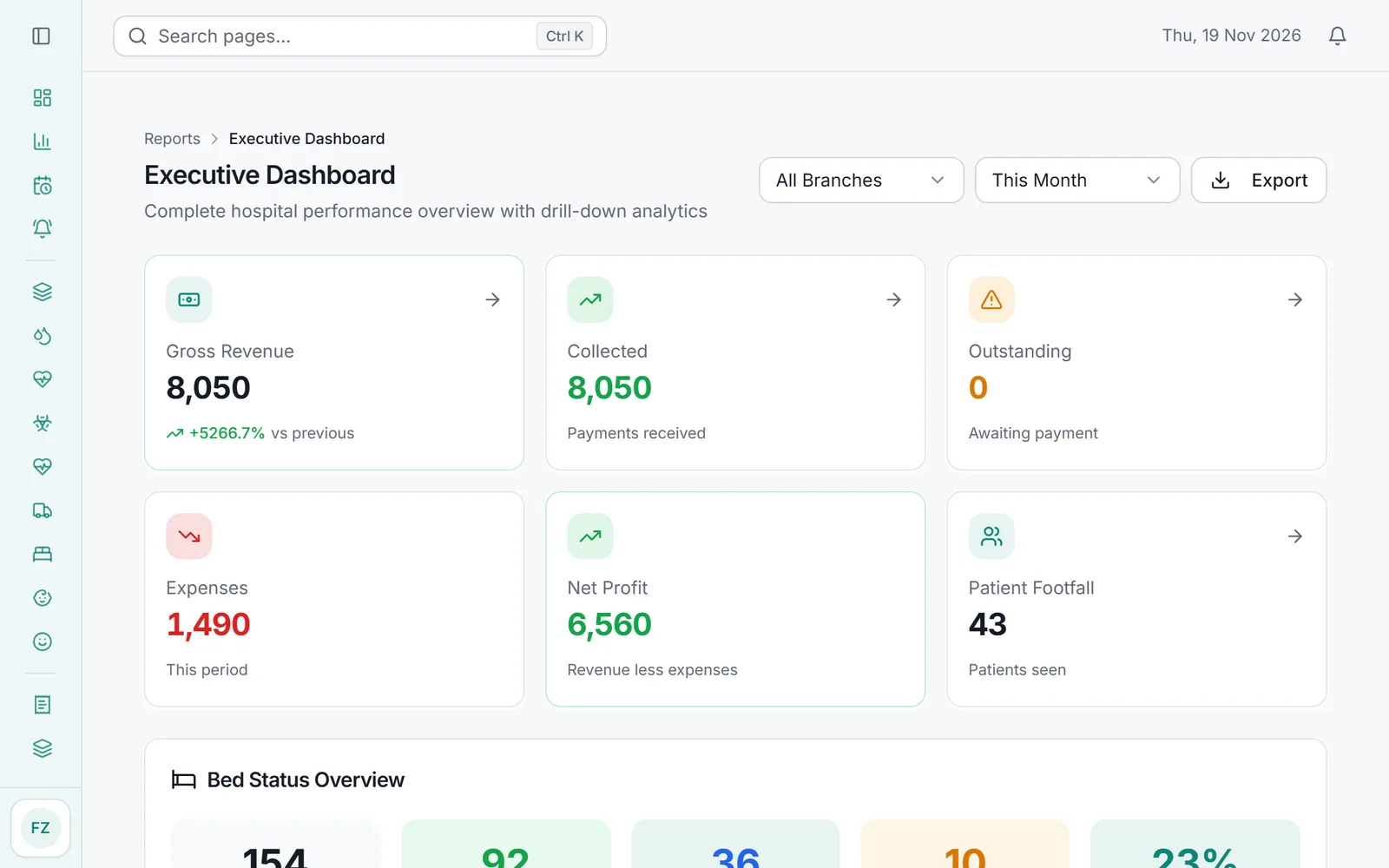
HealthOS 24 is an integrated system. Orders create charges, pharmacy issues reach the inpatient bill, goods received create supplier payables, and invoices, receipts and payroll post their own double entry journals.
Where a hospital keeps a specialist system, such as a laboratory analyser or an existing device, HealthOS 24 has an integrations area for connections, mappings and message logs, so the exception stays an exception.
One integrated system compared with separate departmental systems
| Area | Separate systems | One integrated system |
|---|---|---|
| Data entry | The patient and charges are entered in each system | Entered once and used everywhere |
| Missed charges | Orders and issues can fail to reach the bill | Orders create the charge on the bill |
| Reconciliation | Daily matching of totals between systems | One ledger fed by every department |
| Reporting | Figures combined from several exports | Reports drawn from one database |
| Depth in one area | A specialist tool can go further in its own department | Broad coverage, with interfaces for specialist needs |
| Cost of integration | Interfaces to build, maintain and repair after upgrades | No internal interfaces to maintain |
| Vendors | Several contracts and support lines | One contract, with dependence on one vendor |
Which modules matter most here?
What do buyers ask about One System vs Separate Systems?
Is an integrated HMS always better?
Not always. A specialist tool can be deeper in one department. For most hospitals the savings in data entry, reconciliation and missed charges outweigh that depth, but a large reference lab or imaging centre may justify a specialist system.
Can we keep our existing accounting package?
You can, but you then need an interface or manual posting from the hospital system. HealthOS 24 includes its own double entry ledger, so most hospitals do not need a separate package for hospital operations.
What is the biggest hidden cost of separate systems?
Staff time spent reconciling totals between systems, and charges that are lost because an order in one system never reached the bill in another.
How do we reduce the risk of relying on one vendor?
Agree in the contract how your data is exported, in what format, and how quickly, and check that reports can be exported to Excel day to day.
See HealthOS 24 on your own workflow.
We walk you through it with your departments, rates and reports in mind.