Every department of the hospital on one patient account.
HealthOS 24 runs outpatients, wards, the emergency department, theatres, ICU, diagnostics, pharmacy, billing and finance in one system, so each patient has one record and one running account. Every department works from that record, charges reach the bill as they happen, and finance sees the result in the ledger without rekeying.
Why do multispecialty hospitals struggle with separate systems?
When the lab, pharmacy, radiology and billing each run their own software, the patient is registered several times and charges travel between departments on paper or by phone. The final bill is assembled at discharge, and anything that did not make it across is simply lost revenue.
Clinical teams suffer too. A doctor in the ward cannot see what was given in the emergency room, and the pharmacist cannot see the allergy recorded in OPD. One shared record removes these gaps rather than trying to bridge them with interfaces.
Which departments does HealthOS 24 cover?
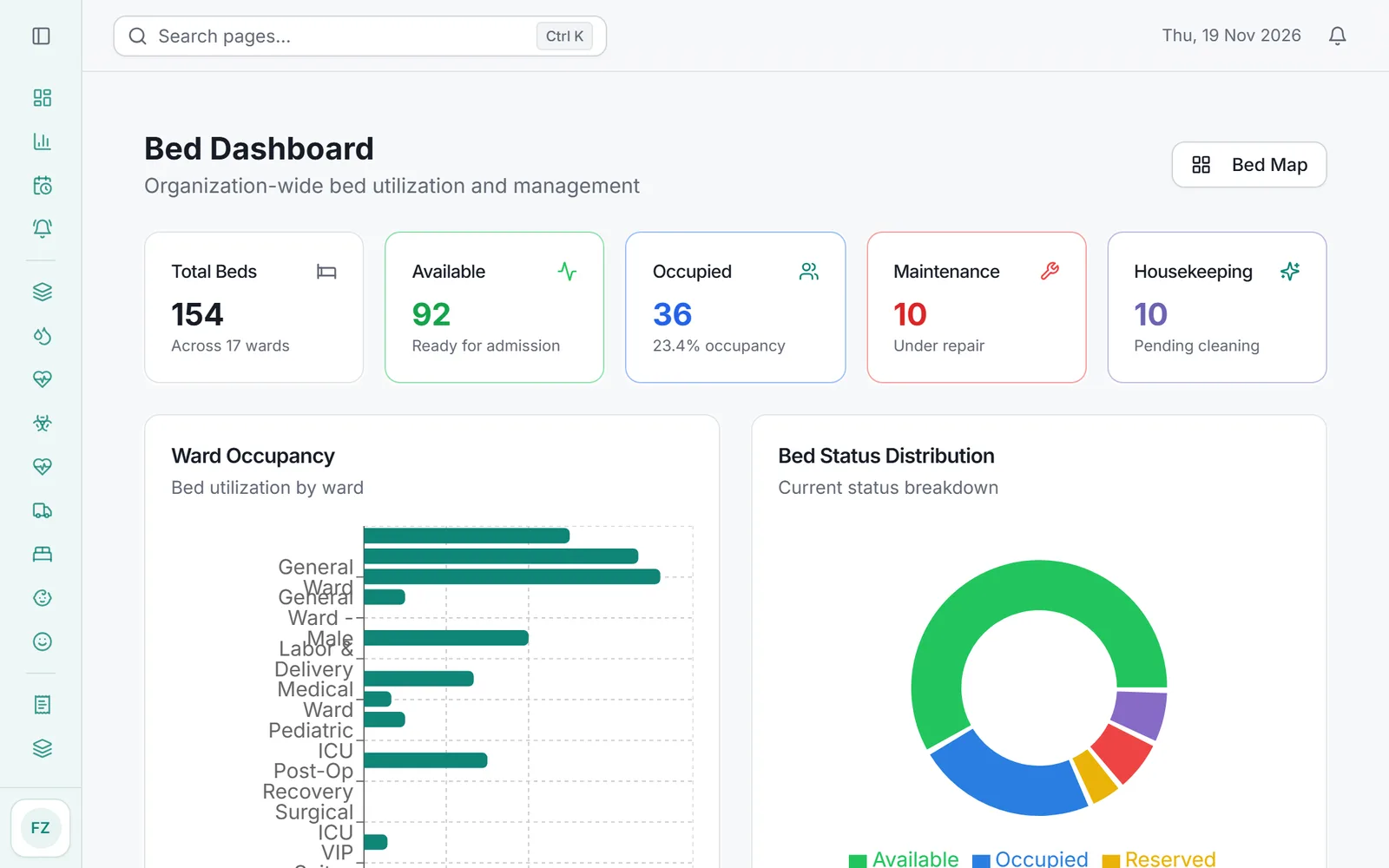
The clinical modules cover the full path of a hospital patient. Outpatients have tokens, vitals, SOAP notes and prescriptions. The emergency department has five level triage, a medico legal register and ambulance trips. Wards have bed maps, early warning scores and an eMAR. Theatres have scheduling, the WHO safety checklist, consent, anaesthesia records and PACU recovery. ICU has its own bed board, critical care charting, care bundles, score calculators and handover.
Diagnostics and support services sit on the same record: the laboratory with verification and letterhead reports, radiology with modality worklists and structured reports, the blood bank with cross matching, and the pharmacy with batch and expiry stock.
- OPD, IPD, emergency and ambulance
- Operation theatre and ICU
- Laboratory, radiology and blood bank
- Pharmacy, stores and procurement
- Billing, accounts, HR and payroll
How does one patient account work across departments?
An admission opens one account that runs until discharge. Room rent follows the bed, ward medicines, lab tests, imaging, theatre consumables and consultant visits are charged as they are raised, and deposits are netted off. A patient admitted from the emergency room carries their notes, medicines and charges into the admission.
Billing staff can see the running bill at any time, and the discharge invoice applies panel and insurance cover with payer and patient shares kept separate. Invoices, receipts and refunds post double entry journals, and surgeon, anaesthetist and consultant shares are credited when payment is confirmed.
What reporting do department heads and the board get?
A single report hub groups clinical registers, revenue, pharmacy, stock, HR and finance reports by department. Reports filter by date, department or doctor and export to Excel, so a medical director and a finance head can read the same numbers.
Revenue by department shows how each service line is performing, and specialist dashboards cover areas such as ICU occupancy and length of stay. Trial balance, profit and loss and the balance sheet are available on demand from the same ledger the departments post to.
How is access controlled when hundreds of staff use one system?
Access is role based. Administrators decide what each role can see and do, and roles can be set per branch. Sensitive actions such as verifying lab results, giving discounts or issuing refunds are limited to staff with that permission, and exceptions route for approval.
Tenant isolation is enforced in the database, not only in the screens, and an audit log records who did what. Staff see the modules their role needs, which keeps a large system usable for a ward nurse as much as for an accountant.
Hospital needs and how HealthOS 24 handles them
| Need | What goes wrong without a system | How HealthOS 24 handles it |
|---|---|---|
| Patient identity | The same patient is registered separately in each department. | One medical record number and one history across every department. |
| Inpatient charges | Ward, pharmacy and lab slips are chased at discharge and some are missed. | Every order charges the same admission as it is raised. |
| Emergency handover | Notes and charges are rewritten when the patient moves to a ward. | Admission from the emergency record carries notes, medicines and charges across. |
| Theatre fees | Surgeon and anaesthetist fees are calculated by hand after the case. | Fees are credited to each doctor when the case is completed and paid. |
| Department revenue | Figures are compiled from several systems into a spreadsheet. | Revenue by department and doctor in one report hub, exportable to Excel. |
| Access control | Shared logins and no record of who changed what. | Role based permissions per branch, approval for exceptions and an audit log. |
What do buyers ask about Multispecialty Hospitals?
Does HealthOS 24 include ICU and theatre modules?
Yes. The operation theatre module covers scheduling, the WHO safety checklist, consent, anaesthesia and recovery. ICU has its own bed board, critical care charting, care bundles and handover.
Is there one bill for an inpatient who used many departments?
Yes. The admission keeps one running account, and ward, pharmacy, lab, radiology and theatre charges land on it as they are raised.
Can department heads see their own figures?
Yes. The report hub filters by department, date and doctor, and revenue is reported by department.
Can access be restricted by role?
Yes. Administrators set what each role can access, per branch, and sensitive actions such as verification, discounts and refunds need the right permission.
See HealthOS 24 on your own workflow.
We walk you through it with your departments, rates and reports in mind.