Good operation theatre management means every case is booked without clashes of room, surgeon or anaesthetist, passes the WHO surgical safety checklist, has its anaesthesia and consumables recorded during the case, and is billed once when it completes, with the surgeon and anaesthetist credited from that same bill. Theatres are among the most expensive hours in a hospital, so small gaps in scheduling or charging add up quickly. This guide walks through each stage and what to check.
What makes theatre scheduling go wrong?
Most theatre lists still begin in a diary or on a board outside the theatre complex. That works until two consultants book the same room, an anaesthetist is listed in two theatres at once, or a case runs long and the afternoon list collapses. Each clash costs theatre time, and cancelled cases on the day are hard on patients who have fasted and prepared.
A scheduling system should check three things at the moment of booking: is the room free for the expected duration, is the surgeon free, and is the anaesthetist free. It should also make the expected duration part of the booking, because a check that assumes every case takes the same time will miss real overlaps.
What has to happen before the patient reaches theatre?
Preparation is where many cancellations on the day begin. A patient who arrives without consent, without results or without anaesthetic review cannot safely go ahead.
- Consent signed by the patient and the surgeon, captured before the case is confirmed
- Preoperative assessment, with any outstanding investigations ordered in advance
- Anaesthetic assessment covering ASA class, airway and Mallampati score, and difficult airway risk
- Surgical team members confirmed, so the anaesthetist and assistants know they are on the list
- Theatre consumables and drugs planned, ideally from an order set for the procedure
What does the WHO surgical safety checklist cover?
The World Health Organization checklist splits every operation into three pauses. Each one is short, but each catches a different kind of error, and the value comes from doing all three every time rather than ticking the form afterwards.
| Phase | When | Typical checks |
|---|---|---|
| Sign in | Before induction of anaesthesia | Identity, site marked, consent, anaesthesia safety check, pulse oximeter, allergies, airway and blood loss risk |
| Time out | Before the skin incision | Team introduced, patient, site and procedure confirmed, antibiotic prophylaxis, imaging displayed, critical events discussed |
| Sign out | Before the patient leaves theatre | Procedure recorded, instrument, sponge and needle counts correct, specimens labelled, recovery concerns handed over |
What belongs in the anaesthesia record?
The anaesthesia record is the anaesthetist's account of the case and a key document if anything goes wrong. It should be written as the case happens, not reconstructed afterwards.
A useful record holds the type of anaesthesia, induction time and agents, the airway device and size with any airway complications, drugs given, a running log of vital signs, fluids, blood loss and urine output, and any complications. After the case, recovery in the PACU should be scored, for example with the Aldrete score, before the patient returns to the ward.
How should theatre consumables and fees be billed?
Theatre billing fails in two familiar ways. Items used in the case are written on slips and never reach the bill, or the same surgery is charged twice, once at booking and again at completion. Both are avoided by billing the case once, when it is completed, from what was actually recorded.
Consumables should be marked billable or not, so that items the hospital absorbs are not charged. Surgeon and anaesthetist shares should be calculated from the professional fee and not from consumables, should be earned only once, and should be reversed if the surgery invoice is cancelled. Cancellations with little notice can carry a penalty on a sliding scale that the hospital sets.
How does HealthOS 24 run the operation theatre?
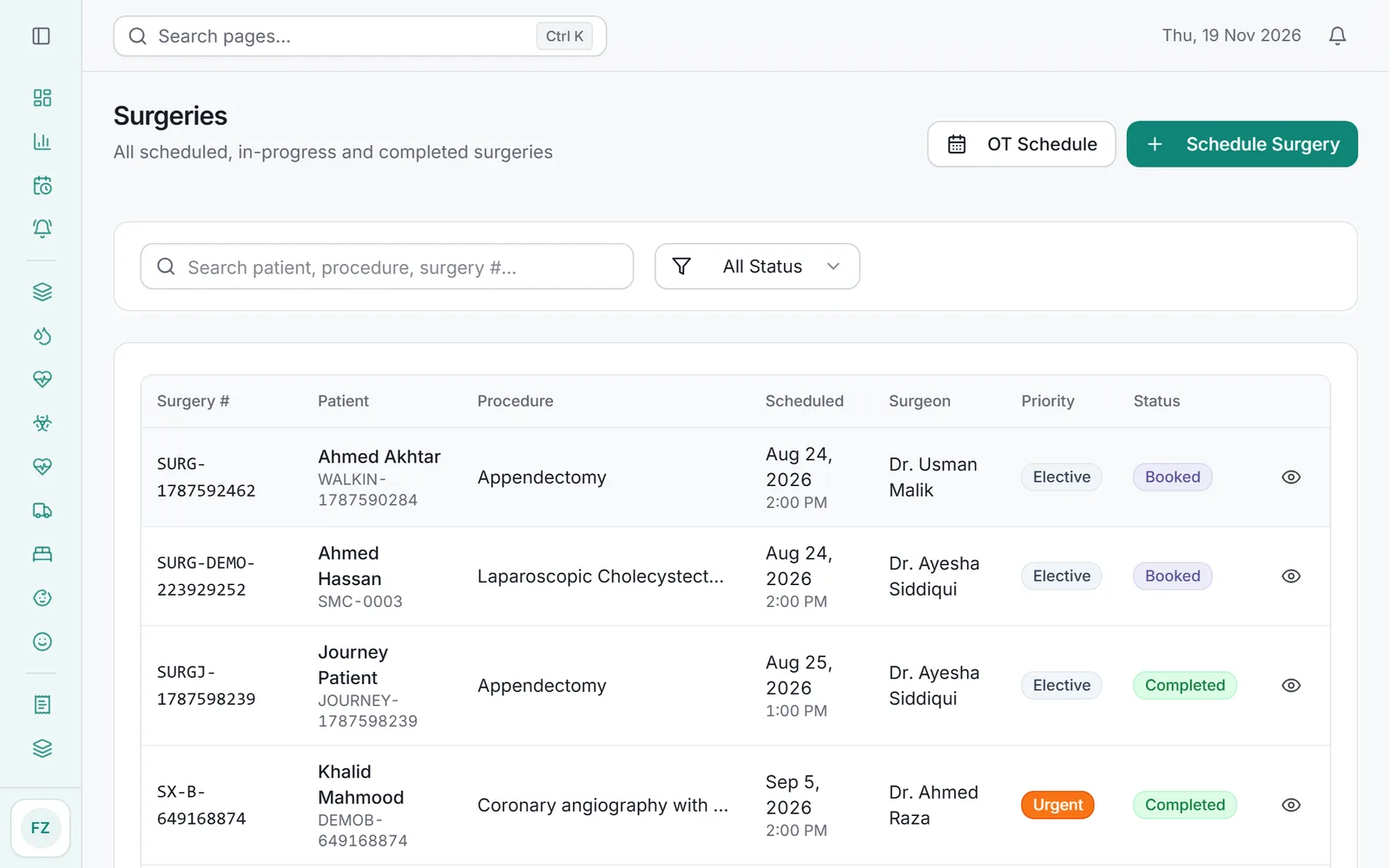
Surgeries are booked by theatre, surgeon, anaesthetist and time, and the booking form checks the room, the surgeon and the anaesthetist for overlapping cases using the expected duration. The theatre board and room calendar show the day's list, and team members confirm their place on each case.
Each case carries digital consent with both signatures, a preoperative assessment, a pre anaesthesia assessment with ASA class and airway review, and the WHO checklist in its sign in, time out and sign out phases. During the case, staff record the anaesthesia record with its vitals log, intraoperative and nursing notes, instrument, sponge and needle counts, and consumables. PACU records recovery with an Aldrete score before discharge to the ward.
When the surgery is completed, the database bills it once. For an inpatient with an open admission the charges land on the admission; for a day case or outpatient an invoice is raised immediately. Billable consumables appear as a separate line. Surgeon and anaesthetist shares are earned once from the surgery at each doctor's plan rate, nothing is paid without a plan, and cancelling the invoice reverses the share. A cancellation penalty page applies the hospital's own sliding scale.
Conclusion
Theatre time is expensive and theatre errors are serious, so the system should do the checking that busy teams cannot. Book against real durations and real availability, complete consent and the anaesthetic review before the day, run all three checklist pauses, record anaesthesia and consumables during the case, and bill once at completion. When fees and shares come from that single bill, the surgical list is safer and the finance team has nothing to chase.
Frequently asked questions
Does the WHO checklist have to be completed for every surgery?
It is designed for every operation, including short and minor cases. Accreditation surveyors commonly look for evidence that all three phases are completed on every case, not only on major surgery.
Can the system stop double booking of a theatre?
HealthOS 24 checks the room, the surgeon and the anaesthetist for overlapping cases at the time of booking and shows any conflict before the booking is saved.
When are surgeon and anaesthetist shares credited?
Once, when the completed surgery is billed, at the rate in each doctor's compensation plan. If the surgery invoice is later cancelled, the share is reversed.
Are theatre consumables charged to the patient?
Consumables marked as billable are charged as a separate line on the surgery bill. Items marked as not billable are recorded for stock and cost but not charged.