A well run emergency department does three things every hospital owner should be able to check: it sees patients in order of severity rather than arrival, it opens a complete medico legal case (MLC) record whenever the law requires one, and it bills emergency care as emergency care. Most problems in casualty come from treating the ER as a busy outpatient clinic. This guide covers triage levels, what a sound MLC register holds and how ER charges should reach the right account.
Why should triage, not arrival order, decide who is seen first?
An emergency department receives patients whose needs range from a cardiac arrest to a minor cut. If they are seen in the order they walk in, the sickest patient can wait behind several who could safely have waited longer. Triage is the short, structured assessment at the door that assigns each patient a level of urgency, so the queue reflects clinical need.
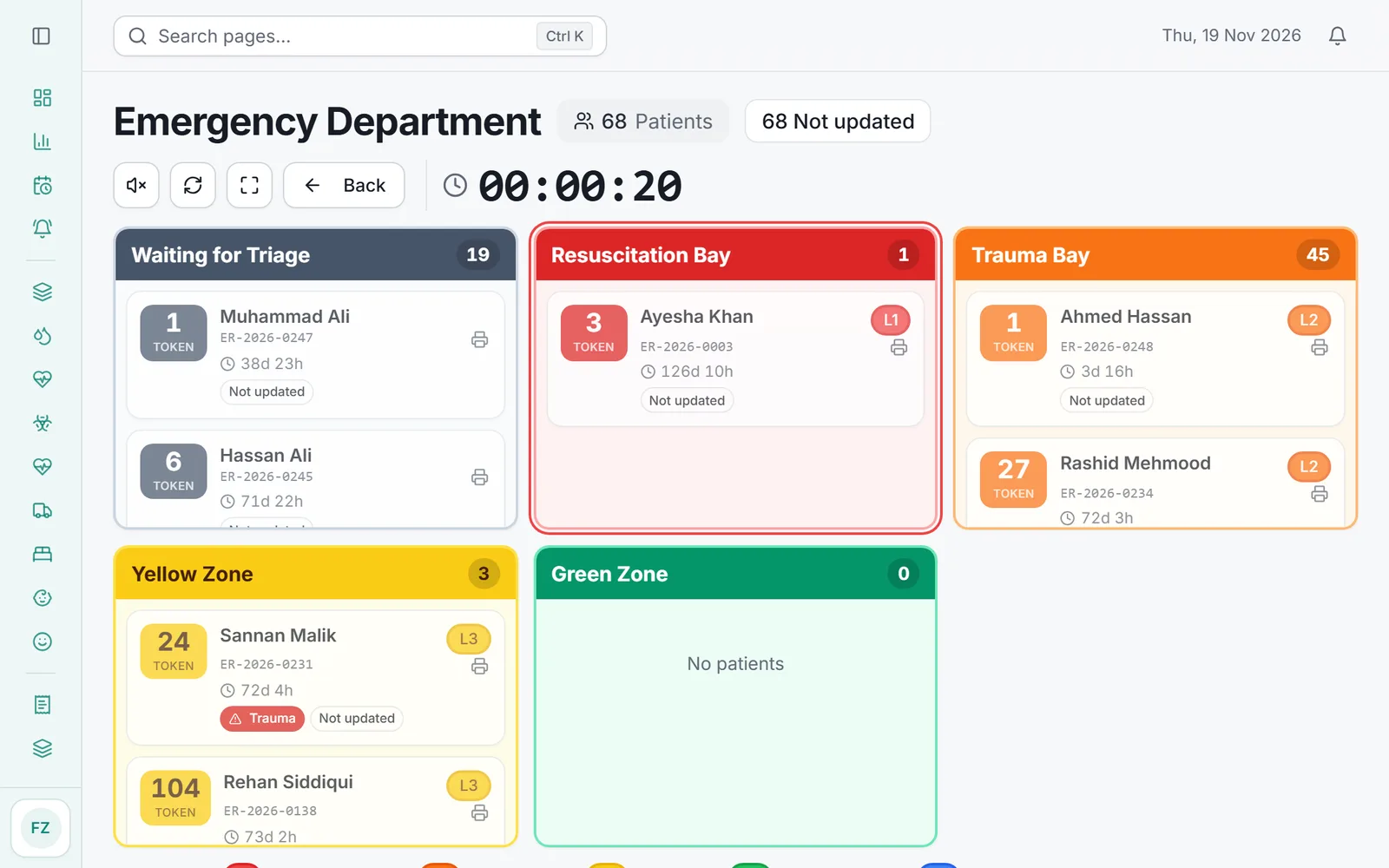
Triage is not a single decision. A patient who deteriorates while waiting must be reassessed and moved up, and a patient who improves can be moved down. That only works when the queue is visible to the whole team and updates as levels change, rather than living on a whiteboard or in the triage nurse's memory.
What do the five triage levels mean?
Most widely used triage scales, including the Emergency Severity Index, the Manchester Triage System and the Canadian Triage and Acuity Scale, use five levels. The names and criteria differ, so a hospital should adopt one scale, train staff on it and audit against it. The table below shows the five colour coded levels used in HealthOS 24.
| Level | Colour | Meaning | Expected response |
|---|---|---|---|
| Level 1 | Red | Immediate threat to life | Resuscitation now |
| Level 2 | Orange | Emergent, urgent care needed | Seen by a doctor without delay |
| Level 3 | Yellow | Urgent, can wait briefly | Seen after higher levels |
| Level 4 | Green | Less urgent | Seen when clinicians are free |
| Level 5 | Blue | Non urgent | May be redirected to OPD |
What is a medico legal case and when should one be opened?
A medico legal case is any presentation where the injury or illness may lead to a police investigation or court proceedings. Typical examples are assault, road accidents, burns, poisoning, firearm and stab wounds, sexual assault, hanging, drowning, electrocution and industrial injuries. In Pakistan the MLC register is a statutory record, and the treating doctor may later be asked to give evidence from it.
The record has to be made at the time, by the doctor who examined the patient. Notes written days later, or reconstructed from memory, carry little weight and expose the hospital to criticism. That is why the MLC should be opened from the emergency visit itself, with the patient's details already filled in.
What should a complete MLC register contain?
Paper MLC registers often hold the police station and an FIR number and little else. A complete record lets the doctor answer the questions a court will ask months later.
- Case type, place of incident and who brought the patient, with name, relation, CNIC and phone
- Police station, officer name and rank, FIR number and daily diary (DD) number
- Level of consciousness and general condition on arrival
- Each injury itemised separately with location, type, size, colour and apparent age
- Medical opinion on the nature of injuries, probable weapon and probable cause
- Evidence preserved, such as clothing and photographs, with a description and count
- Disposition of the patient and any referral
Why is ER billing different from OPD billing?
Emergency patients do not follow the outpatient route of reception, doctor and then cashier. Many are treated before they can pay, some are never identified at first, and a large share are admitted rather than sent home. If the system assumes that anyone not admitted is an outpatient, ER patients end up at a payment counter in the middle of treatment, or their charges are filed under OPD revenue where finance cannot see them.
The second common leak is the move to the ward. When an ER patient is admitted, the charges raised in casualty should follow the patient onto the admission, so there is one continuous account for one episode of care. Two separate invoices, or ER charges left unbilled once the patient is upstairs, are among the most frequent complaints from both patients and finance teams.
- Record ER treatment, medicines and tests as charges on the visit as they happen
- Keep clinicians recording charges and cashiers raising invoices as separate roles
- Carry unbilled ER charges onto the admission when the patient is admitted
- Post ER and ambulance revenue to their own accounts, not to outpatient revenue
How does HealthOS 24 handle the emergency department?
Patients can be registered quickly, including as provisional patients before identity is confirmed. Triage assigns one of the five levels and the emergency queue and display board reorder by severity, showing how long each patient has waited for a doctor. Doctors record treatment, order laboratory and imaging tests, and prescribe from the emergency record.
When a case is medico legal, the doctor opens an MLC record from the emergency visit, carrying across the arrival and police details already captured at registration. The MLC register lists every case with its police station.
Charges are recorded against the ER visit, and the emergency doctor's professional fee is raised once when the patient is first seen. Clinicians can record charges but cannot invoice them; the ER checkout page is the cashier's worklist, and billing requires an open cash session. If the patient is admitted, the unbilled ER charges move onto the admission automatically. ER and ambulance revenue post to their own ledger accounts.
Conclusion
Emergency care goes wrong when it is run like an outpatient clinic. Triage by severity and reassess as patients change, open the MLC record at the time of examination with every injury described, and keep ER charges on the visit until they are either billed at checkout or carried onto the admission. When the software follows that pattern, the department is safer for patients, more defensible in court and easier for finance to reconcile.
Frequently asked questions
Which triage scale should our emergency department use?
Any recognised five level scale can work. What matters is choosing one, training every triage nurse on it, and auditing whether patients were seen within the response your hospital has agreed for each level.
Who is allowed to write the MLC record?
The doctor who examined the patient should complete it at the time of examination. Hospitals should also follow local rules on which grade of doctor may sign medico legal reports.
Can an unidentified emergency patient be treated and billed?
Yes. The patient can be registered as provisional, treated and charged on the ER visit, and their identity completed later without losing any of the record.
What happens to ER charges when a patient is admitted?
In HealthOS 24 the unbilled ER charges move onto the admission, so the patient receives one bill for the whole episode instead of a separate emergency invoice.