A safe hospital blood bank can trace every unit in both directions: from the donor and the screening tests to the patient who received it, and from a patient's transfusion reaction back to the donation. That depends on four controls working together: donor eligibility, quarantine until screening is complete, stock managed by component and expiry, and a recorded crossmatch before issue. This guide explains each control and what blood bank software should enforce.
Why does traceability matter so much in a blood bank?
Blood is a biological product with a short life, given to patients who are often very unwell. When something goes wrong, such as a transfusion reaction or a donor who later tests positive for an infection, the blood bank must answer two questions quickly: which patients received units from this donor, and which donation did this patient's unit come from.
Paper registers make those questions slow and uncertain, because the donor book, the testing log, the crossmatch slips and the ward charts are kept in different places. A linked electronic record answers both in a few clicks, and makes it much harder to issue a unit that has not completed every step.
What should donor screening cover?
Screening protects both the donor and the recipient. It begins before collection, with registration, a health questionnaire and a haemoglobin check, and continues in the laboratory once the unit is collected.
- Donor identity, blood group and contact details for recall
- Haemoglobin level recorded at each donation
- Minimum interval since the last donation before the donor is eligible again
- Temporary deferral or permanent deferral, with the reason kept on record
- Laboratory screening of every unit for HIV, hepatitis B, hepatitis C, syphilis and malaria, following national requirements
How should blood stock be managed by component and expiry?
Most donations are separated into components, and each component has its own storage conditions and shelf life. Stock should therefore be counted by blood group and component together, not by blood group alone, and the oldest suitable unit should be used first so that units are not lost to expiry.
Every unit should move through clear statuses. A unit stays in quarantine until screening is complete, becomes available only when results are non reactive, and is discarded with a recorded reason if any result is reactive or the unit expires.
| Status | Meaning | What should happen next |
|---|---|---|
| Quarantine | Collected, screening not complete | Run screening tests |
| Available | Screened and non reactive | Can be reserved or crossmatched |
| Reserved or crossmatched | Allocated to a named patient | Issue to the ward when requested |
| Issued | Released from the blood bank | Transfuse with bedside checks |
| Transfused | Given to the patient | Monitor and record any reaction |
| Expired or discarded | Not usable | Record the reason and remove from stock |
What does a crossmatch prove before a unit is issued?
A crossmatch tests the patient's sample against the donor unit to confirm compatibility before transfusion. The major crossmatch tests the patient's serum against donor red cells and is the critical check for red cell transfusions; the minor crossmatch tests donor plasma against the patient's cells. The result, the person who performed it and the unit it applies to should all be recorded.
One quiet risk sits before the crossmatch: the blood group on the request. If a form demands a group and staff fill in a guess for an ungrouped patient, the blood bank receives a confident and wrong instruction. A request should be allowed to say the group is unknown, so that the laboratory groups the sample instead of trusting the form.
What should be recorded at transfusion?
The transfusion record closes the chain. It should link the patient, the request, the unit and the crossmatch, record when the transfusion started and finished, and allow staff to stop it at once if a reaction occurs. A reaction should be documented with the patient's vital signs at the time, so the blood bank and the treating team can review it and trace the donation if needed.
How does HealthOS 24 manage the blood bank?
HealthOS 24 keeps a register of donors with blood group, haemoglobin, donation history, deferred and permanently deferred statuses, and an eligibility check based on the time since the last donation. A donor recall list filters eligible donors by blood group, or to the groups that are low in stock, with call, WhatsApp and email shortcuts.
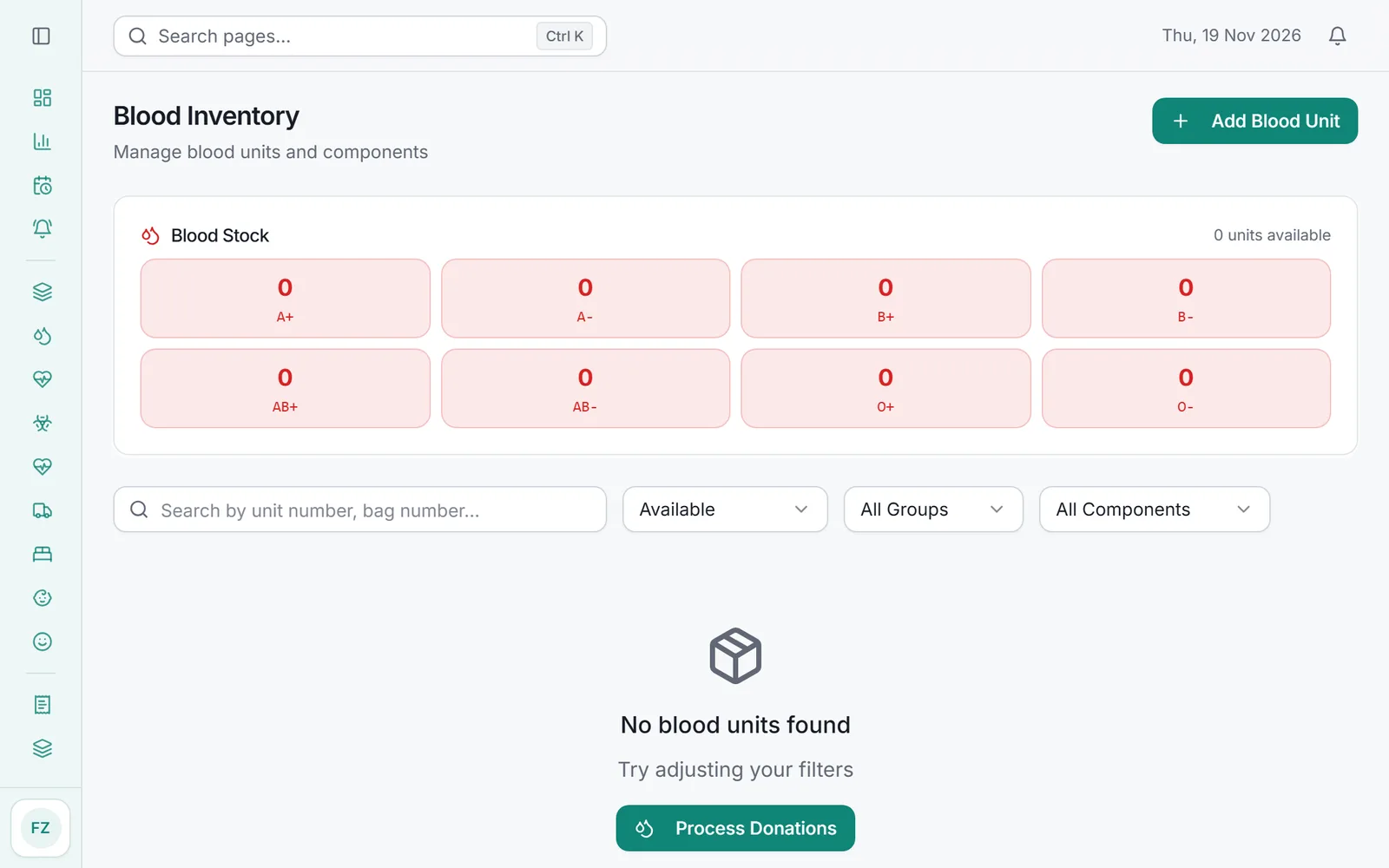
Each donation creates a unit by component: whole blood, packed red cells, fresh frozen plasma, platelet concentrate, cryoprecipitate or granulocytes. Units start in quarantine, and the screening page records HIV, hepatitis B, hepatitis C, syphilis and malaria results; a reactive result discards the unit. The inventory shows stock by group and component with expired and expiring units flagged, discards require a reason, and bag labels can be printed for selected units.
Blood requests may be raised with the group left unknown, in which case the patient's recorded group is used if one exists. Crossmatches record major and minor results and compatibility. A transfusion links the request, unit and crossmatch, reserves the unit, and can be completed or stopped, with a reaction form that captures vital signs at the time of the reaction.
Conclusion
Blood bank safety rests on a chain that cannot have gaps: an eligible donor, a quarantined and fully screened unit, stock managed by component and expiry, a recorded crossmatch and a documented transfusion. When each step is linked in one record, the blood bank can trace any unit in either direction, waste less to expiry and show inspectors exactly how each transfusion was made safe.
Frequently asked questions
Why are blood units quarantined after collection?
Screening results are not available at the moment of donation. Quarantine keeps the unit out of usable stock until every test is complete and non reactive.
What is the difference between a major and a minor crossmatch?
A major crossmatch tests the patient's serum against the donor's red cells. A minor crossmatch tests the donor's plasma against the patient's red cells. The major crossmatch is the essential check before giving red cells.
How do we reduce blood wasted to expiry?
Count stock by group and component, use the oldest suitable unit first, review units close to expiry every day, and recall donors by group before stock runs low rather than after.
Can a blood request be raised when the patient's group is not known?
Yes. In HealthOS 24 the group can be left unknown, so the laboratory groups and crossmatches the sample rather than relying on a guessed group on the form.